The Benefits of Replacing Your Roof: Why Now is the Time to Upgrade
A new roof is one of the most important investments you can make in your home. It protects your family from the elements, and it can add value to your property. Read more


As A GAF Master Elite Roofing Installer, Armor Xteriors Of Chattanooga Has The Answers To Some Of Your Most Common Roofing Questions.
A new roof is one of the most important investments you can make in your home. It protects your family from the elements, and it can add value to your property. Read more
Although the weather can’t seem to make up its mind (welcome to the Southeast) spring is officially upon us, and that means our homes need some post-winter TLC. It’s time to tackle that pesky moss that has grown up on your roof, sidewalk, lawn, and just about everything else outdoors. Spring is the perfect time to arm your home against insects and pests, and everyone’s favorite, organize the garage and attic. Read more
Your roof is a crucial component of your home, and it’s essential to understand its life expectancy to ensure that you’re prepared for the cost of replacement. One of the most popular roofing materials used in residential homes is shingles. But how long should a shingle roof last? In this article, we’ll examine the factors that impact the life of a shingle roof and provide tips for extending its lifespan.
The life of a shingle roof is influenced by several factors, including:
The honest answer depends on which shingle you have — “20-25 years” is a fine average, but it hides a real range:
As a GAF Master Elite contractor, Armor Xteriors installs GAF’s full lineup, including Timberline HDZ — GAF’s most popular architectural shingle, which carries a lifetime limited warranty when installed by a certified contractor. That warranty backing is a real, meaningful difference from a lower-tier shingle installed by a non-certified crew, even if the two shingles look identical on the roof.
What actually shortens these numbers in Chattanooga specifically: our humidity, seasonal storms, and swings between summer heat and winter cold all accelerate wear compared to a drier, more stable climate. A roof with proper ventilation, flashing, and underlayment will consistently outlast an identical roof without it — installation quality genuinely matters as much as the shingle itself.
While shingle roofs can last for 20-25 years, it’s essential to be aware of the signs that it’s time to replace your roof. These signs include:
To extend the life of your shingle roof, it’s crucial to take steps to protect it from weather and other environmental factors. Here are some tips for maintaining your roof and extending its lifespan:
Most asphalt shingle roofs last 20 to 30 years. The exact number depends on the shingle type (3-tab, architectural, or premium), installation quality, and local climate.
GAF’s architectural shingles, like Timberline HDZ, are built for 25-30+ years of performance and carry a lifetime limited warranty when installed by a GAF Master Elite contractor.
Not always. That number is a manufacturer rating under ideal conditions. Real-world lifespan depends heavily on ventilation, installation quality, and how much severe weather the roof is exposed to — which is why two identical shingles can perform very differently on two different homes.
Curling or cracking shingles, granules collecting in your gutters, visible sagging, and roof age past 20 years are the clearest signs. If you’re seeing any of these, it’s worth a free inspection rather than waiting for a leak.
Homeowners insurance generally pays to replace a roof damaged suddenly — by hail, wind, a fallen tree, fire. It generally does not pay for a roof that simply wore out. Not sure which category your roof falls into? See how long a roof should last and the signs it needs replacing.
That much most people know. What catches Chattanooga homeowners off guard is the rest: the first check arriving far smaller than the estimate, and the insurer offering to replace one slope of a roof when the shingles on it haven’t been made in twelve years.
Both of those have specific answers in Tennessee.
Most policies treat these as covered perils:
The line insurers draw is sudden versus gradual. An adjuster’s job on a roof claim is largely deciding which side of that line your damage falls on.
This is the single most common phone call we get after a claim is approved, and it usually isn’t a problem at all.
Most policies pay roof claims in two parts:
The first check is Actual Cash Value (ACV). That’s the cost to replace your roof minus depreciation for the years of life it had already used, minus your deductible. On a 14-year-old roof, that can be dramatically less than the full replacement cost.
The second check is the recoverable depreciation. Once the work is finished and your contractor submits the final invoice, the insurer releases the rest — provided your policy is a Replacement Cost Value (RCV) policy.
So a $24,000 roof on an RCV policy with a $2,000 deductible might arrive as a first check of $13,000, then a second check of $9,000 after completion. You pay the $2,000.
The exception that matters: if your policy is ACV-only, there is no second check. Many policies switch older roofs — often past 15 or 20 years — to ACV-only, or apply a roof surface payment schedule that pays a declining percentage by age. Look for “roof surface” language in your declarations page. If you find it, you’ll be covering more of the cost yourself, and it’s worth knowing that before the storm, not after.
Here’s the part most homeowners have never heard of.
Say hail hits one slope of your roof. The insurer approves replacing that slope only. But your shingles were discontinued years ago, and the closest available match is visibly different in color. You’d end up with a two-tone roof.
Tennessee has a rule for this. Rule 0780-01-05-.10(1)(b), confirmed by the Tennessee Commissioner of Insurance and effective October 9, 2017, requires that when replacement cost coverage applies and replacement items deviate in quality, color or size, the insurer “shall replace items so as to conform to a reasonably uniform appearance.”
It explicitly covers exterior losses, not just interior ones — which was the point of the Commissioner clarifying it, since some insurers had been paying to repaint a whole interior wall while refusing to address a mismatched roof.
Two limits worth being honest about:
This applies to siding as well as roofing. If a storm damages one elevation of your siding and the product line has been discontinued, the same reasoning is in play.
If you’re told you’re getting a partial replacement in a color that won’t match, that rule is worth raising by name with your adjuster.
This matters more than it sounds, and it’s how you tell a legitimate roofer from a storm chaser.
We cannot negotiate your claim for you. Under the Tennessee Public Adjuster Licensing Act (Tenn. Code Ann. § 56-6-903), adjusting a claim on a homeowner’s behalf requires a public adjuster license. A roofing contractor without one can inspect your roof, document damage, provide an estimate, and meet the adjuster on site to walk the damage together. Negotiating the settlement on your behalf is a different activity and requires a license.
We cannot pay your deductible. Your deductible is your obligation under your policy. A contractor who offers to “cover it,” “eat it,” or “work it into the paperwork” is proposing to bill your insurer for money you never paid — that’s fraud, and it’s the homeowner’s name on the claim.
No one can promise you a full roof replacement before an inspection. Anyone knocking on your door after a storm promising approval hasn’t seen your roof or read your policy.
It can, and a weather-related claim is treated differently by different carriers. A denied claim can still appear in your claims history. This is worth a direct conversation with your agent before filing a marginal claim.
There’s no universal cutoff. What changes with age is how you’re paid — many policies move older roofs to ACV-only or a declining payment schedule. A 25-year-old roof with genuine hail damage may still be a valid claim; it just may not pay much.
No. You can request a re-inspection, and most policies contain an appraisal clause for resolving disputes over the amount of a loss. If you believe damage was missed, a second set of eyes on the roof is reasonable.
Insurance pays to restore what you had. If you want an upgrade — a better shingle line, a metal roof — you can generally apply the claim settlement toward it and pay the difference.
That’s exactly what the matching rule above addresses. Raise it with your adjuster by name.
Read carefully what you’re signing. Some post-storm agreements assign your claim benefits to the contractor or lock you in regardless of the outcome. A straightforward inspection doesn’t require you to sign anything binding.
This is general information, not legal or insurance advice. Policies differ, and your coverage is determined by your specific policy language. For questions about your coverage, talk to your agent.
Chattanoogas winter weather tends to bring out the issues of an aging roof. If you decide to replace your roof, you may be wondering, “Can a new roof be installed in winter”?
Well, the short answer is, yes, most Chattanooga area roofers know how to replace roofs even in cold weather. Read more
As a Chattanooga area homeowner, you’re most likely only going to buy maybe a few roofs in your lifetime, so choosing the right color is very important to get right the first time. After all, a well-installed shingle roof is a long-term investment — see how long a shingle roof should last before you’ll be picking a color again. The shingle color you choose needs to work with your house and style, complement the neighborhood, and take into consideration any other preferences you may have. Below are some tips to to help you as a homeowner consider the best possible color for their next roof.
Take a look at your homes style—do you have bricks or siding? Is your home painted? What is the overall style of the home?
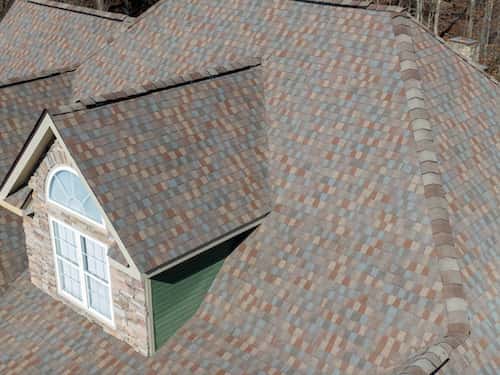
Golden Harvest Shingles
Whether you are in your forever home or plan on selling in a few years, a neutral color will keep your house looking current for years to come. You can also help your home stand out by using more striking colors. Either of these options can increase your home’s curb appeal, which can increase the value of your home.
If you live in a complex run by an HOA, make sure there aren’t any rules for choosing a shingle color before your finalize your decision. Some homeowners associations prefer all homes in within the neighborhood to look the same. If you’re not in a complex, consider your neighbors and what they have on their roofs. If you like your neighbors’ roofs, find out more about similar shingle colors and styles and how they may complement your home. If you want to be a little different and stand out from your neighbors, explore alternative shingle styles and colors that will make your home unique.
Get some samples and look at online tools like the GAF Virtual Home Remodeler to see which color shingle would look best with your home. Also, consider the architectural style of your home. What may look good on a Ranch-style house may not work for a Tutor or Colonial. Drive through different neighborhoods to get ideas and see examples.
Once you have a general idea, or simply need a little more help, give Armor Xteriors a call at (423) 760-3333 or Schedule a free, in-home consultation with one of our roofing experts.