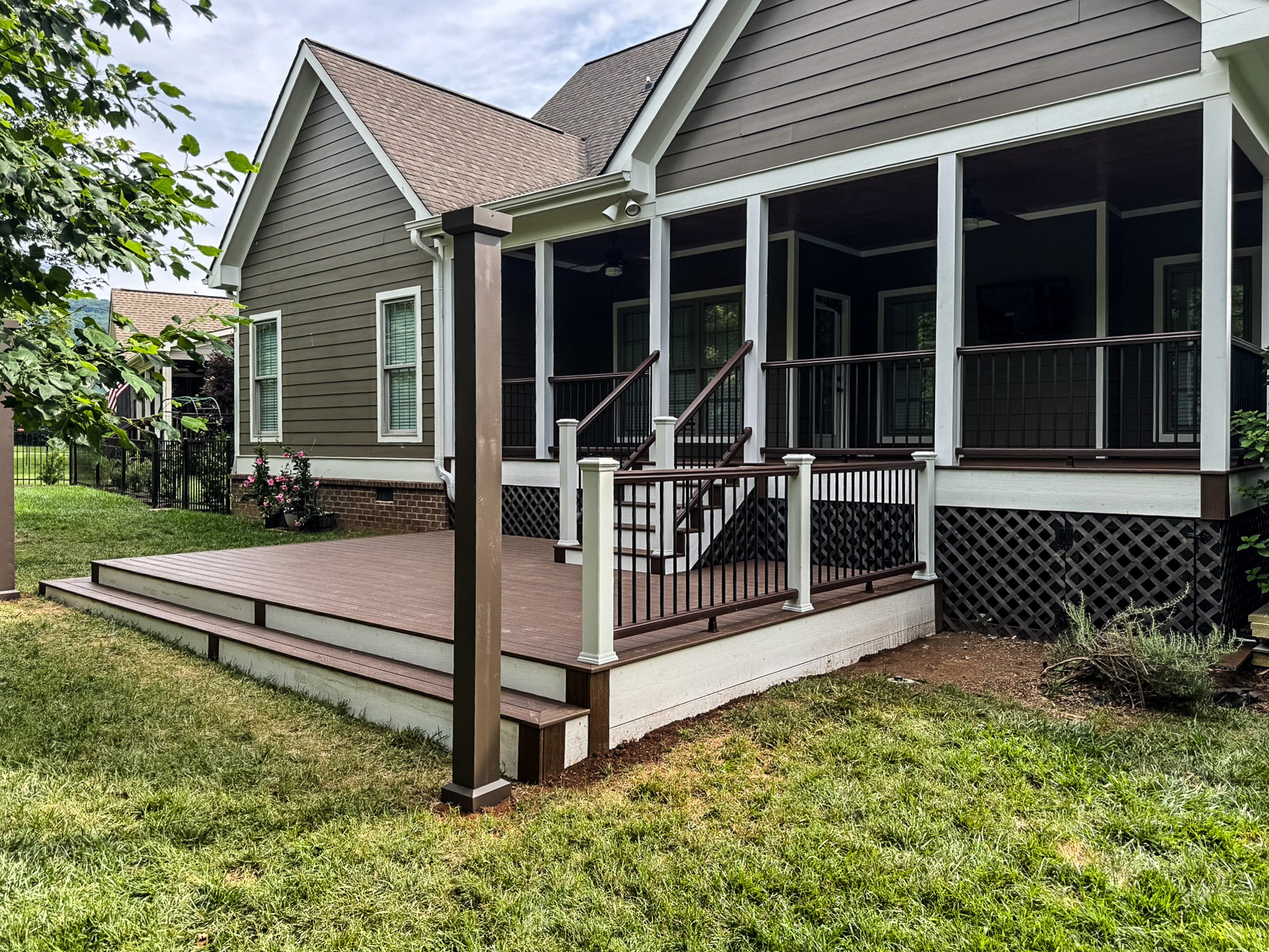
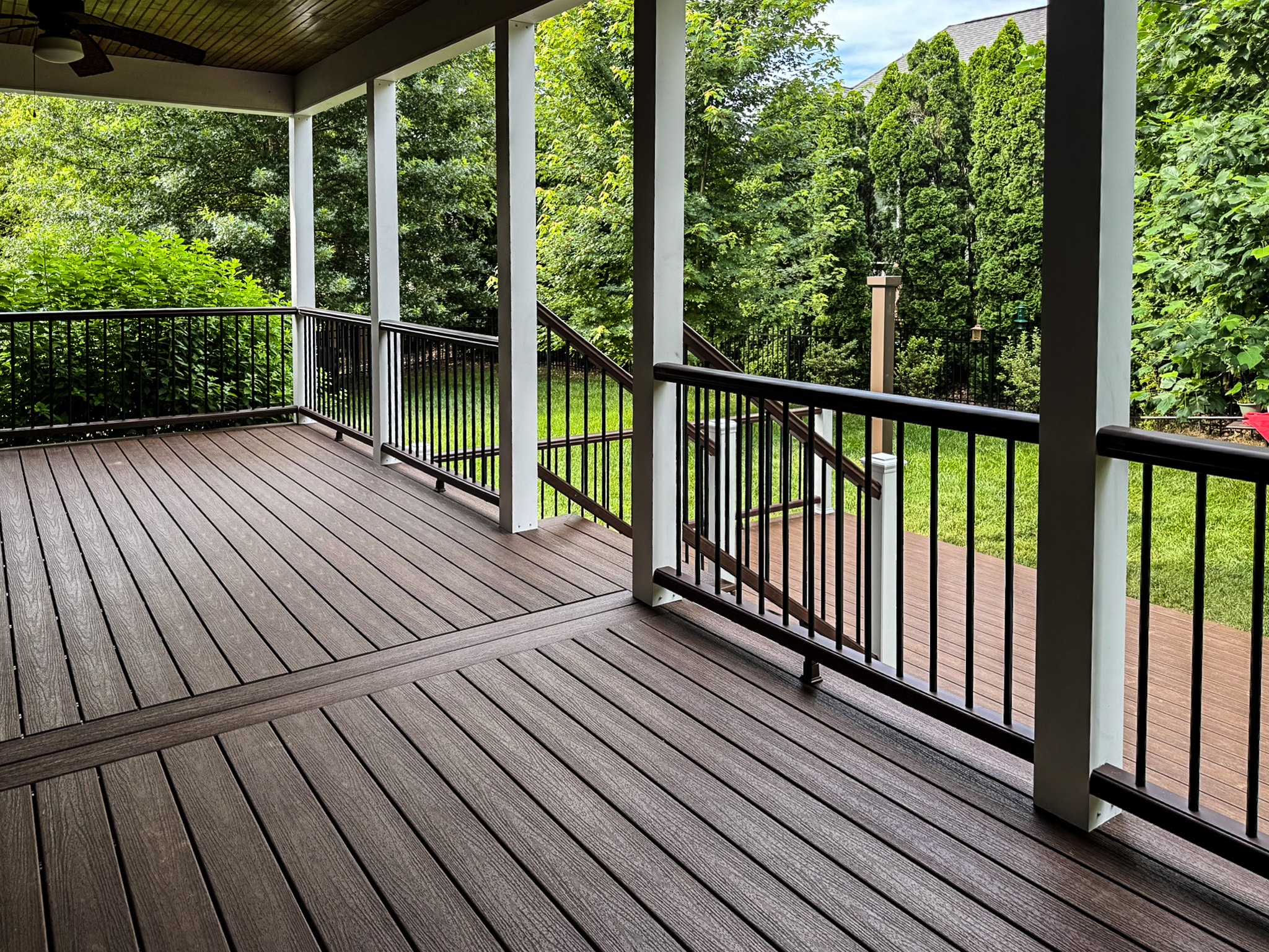
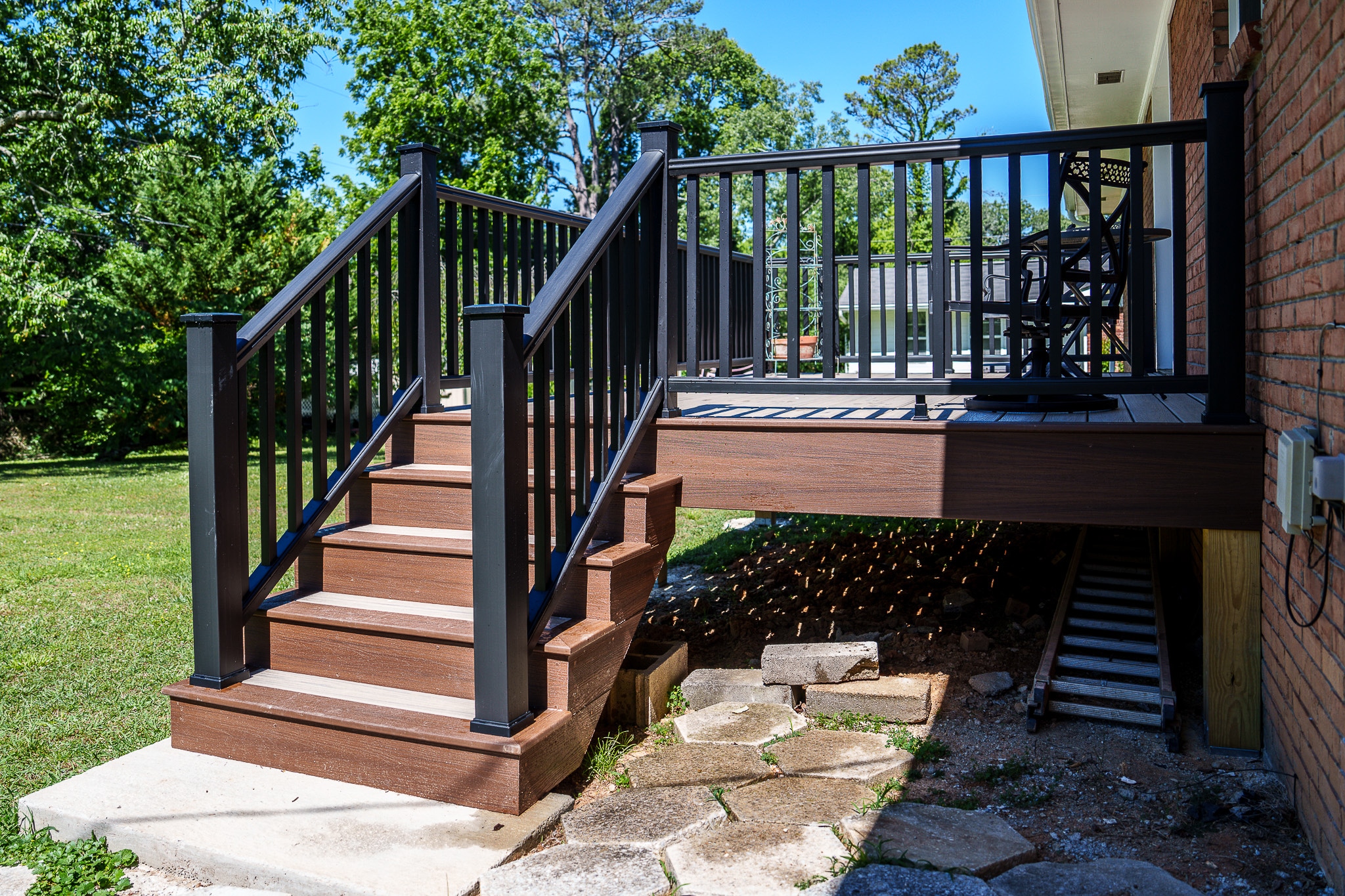
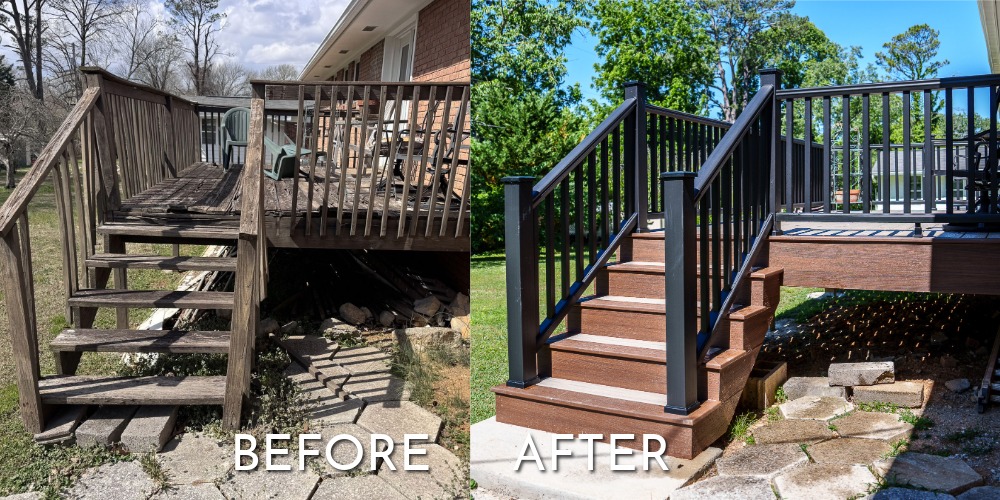
If you’re a homeowner in Ooltewah, TN staring at a cracked, splintering wood deck and wondering whether it’s time for a full replacement, this case study is for you. We recently worked with a local family whose backyard deck and screen room had reached the end of their lifespan — and whose front porch railing wasn’t far behind. Here’s how we transformed their entire outdoor living space using Trex Enhance composite decking and low-maintenance aluminum railing, without sacrificing style or curb appeal. (For another Ooltewah project, see how we solved a soggy under-deck space with the Trex RainEscape under-deck drainage system.)
When a homeowner in the Big Ridge neighborhood of Hixson, Tennessee reached out to Armor Xteriors, their deck had reached the end of the road. Originally built in the early 1980s, the structure was over 40 years old, and decades of Tennessee weather had taken their toll. Half of the deck was open-air, half was screened in, and both sections were showing serious signs of structural fatigue.
Here’s how we turned an aging, unsafe deck into a durable, low-maintenance outdoor living space the homeowners will enjoy for decades.
The Problem: A 40+ Year Old Deck on Its Last Legs
Decks built in the early 1980s were rarely constructed with the materials or building codes we rely on today. By the time we arrived on site, this deck showed several classic signs of end-of-life wood decking:
Soft, spongy boards from decades of moisture exposure
Deteriorating railing that no longer met safety standards
A screened-in section with torn screens and rotting frame components
An open under-deck area with no protection from the elements
Structural components well past their expected lifespan
For a deck pushing 40+ years old, this wasn’t a candidate for spot repairs — it needed a full replacement.
The Solution: A Full Rebuild with Premium, Low-Maintenance Materials
Armor Xteriors designed and built a complete deck replacement using composite materials chosen specifically for Chattanooga-area weather patterns — humidity, heat, and seasonal freeze-thaw cycles.
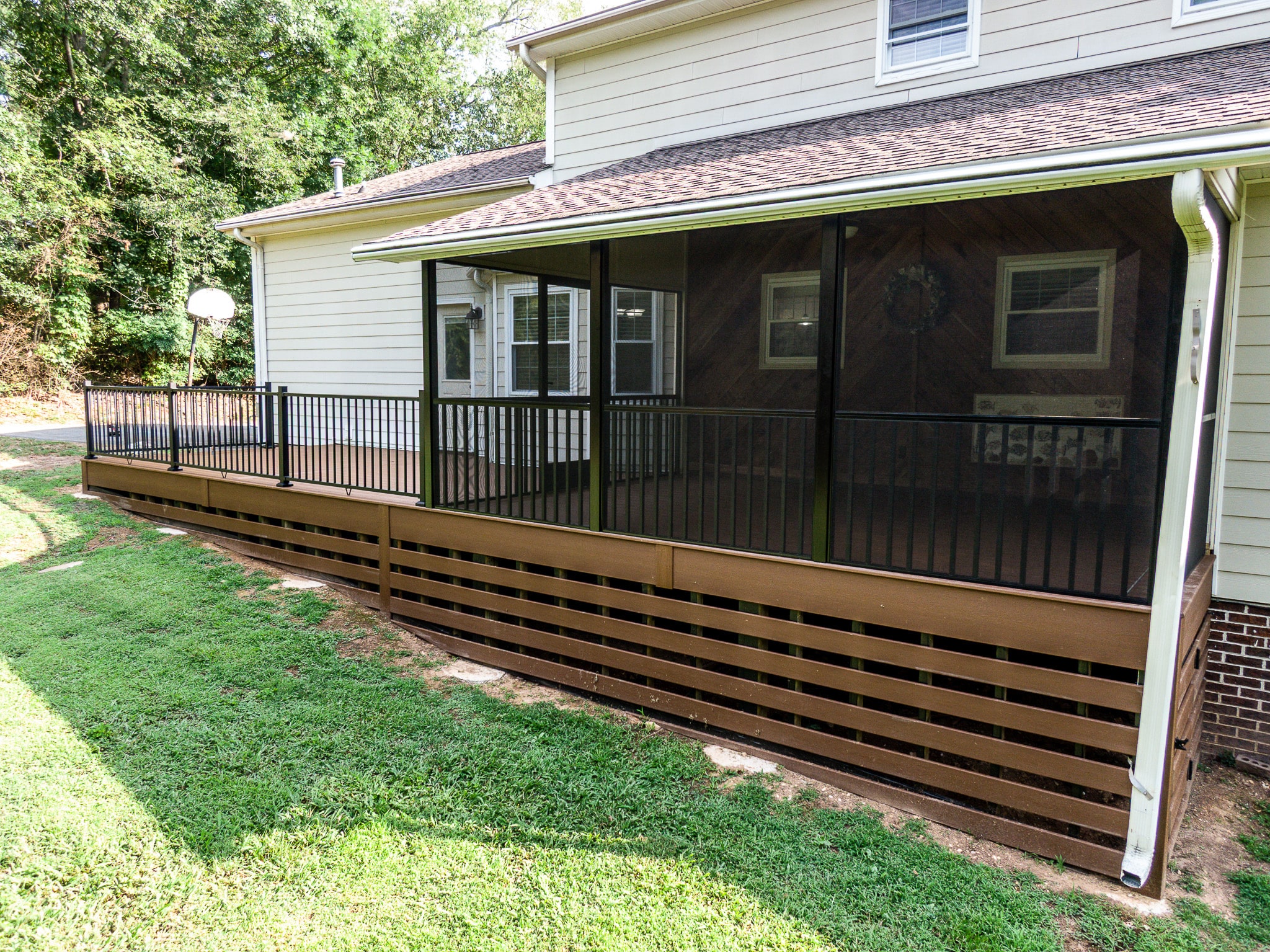
To modernize the look while keeping maintenance minimal, we used black aluminum railing throughout the project, including the screen room area. This accomplished two things:
Created a cohesive, updated look across the entire deck
Matched the surrounding screen framework so the open and enclosed sections feel like one connected space rather than two mismatched additions
Screen Room: Fully Rebuilt to Match
The original screened-in porch was rebuilt from the ground up. We paid close attention to matching the new railing and framing to the screen structure so the transition between the open deck and the screened area reads as one intentional design rather than a patchwork of repairs.
Under-Deck Protection: Custom Trex Fascia Cladding
One of the most impactful upgrades was shielding the under-deck area with custom cladding using Trex fascia boards. This addressed a problem the original 1980s design never solved: exposed framing and joists left vulnerable to moisture and debris underneath the deck. The custom cladding gives the space a clean, finished appearance from every angle — not just from the top.
Project Highlights at a Glance
Age of original structure: 40+ years old
Project scope: Full deck tear-off and rebuild, screen room replacement, under-deck cladding
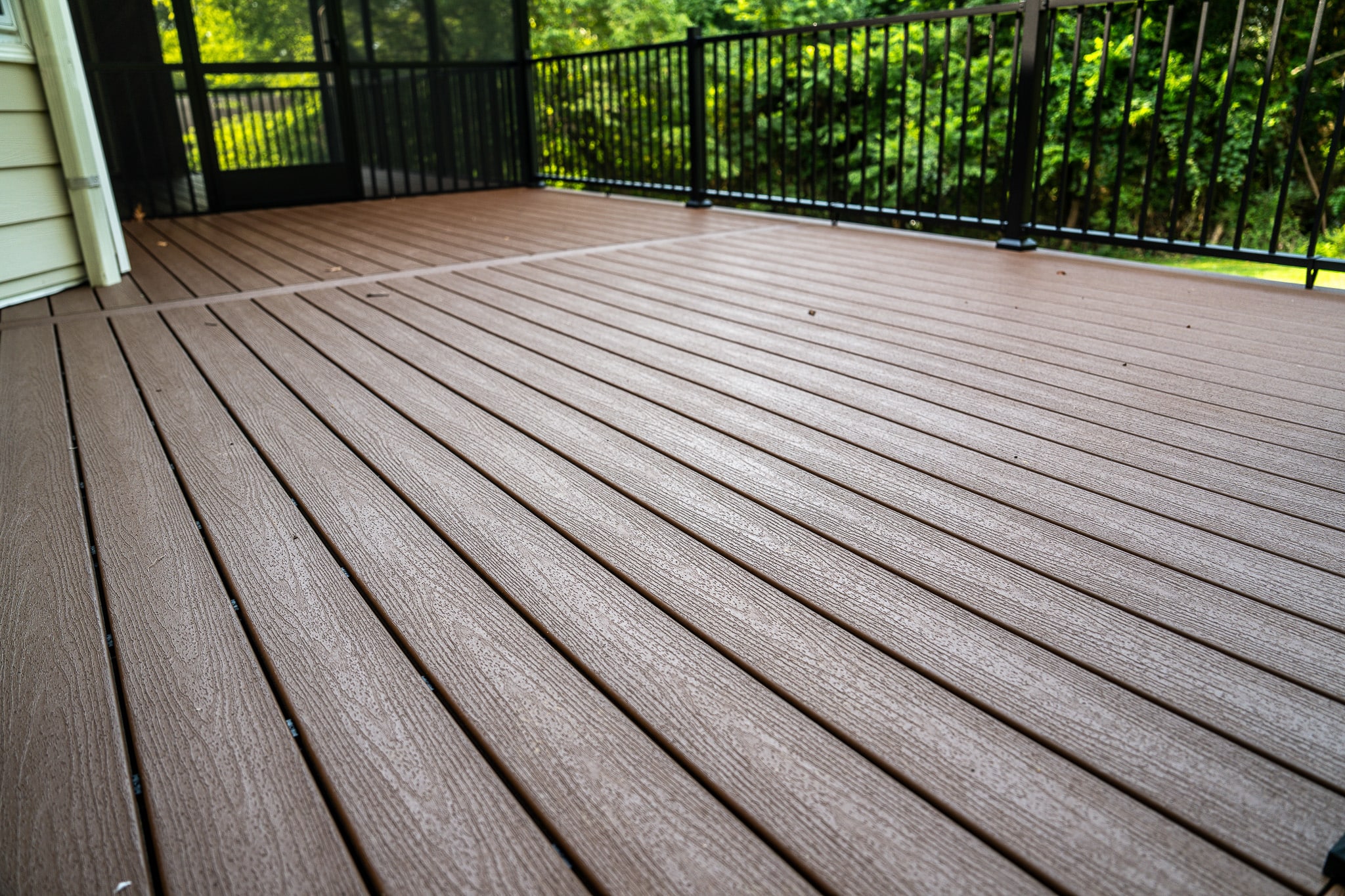
Decking material: Trex Enhance, Saddle color
Railing material: Black aluminum (deck + screen room)
Homeowners throughout Hixson, Big Ridge, and the greater Chattanooga area deal with humid summers, heavy pollen seasons, and everything from thunderstorms to the occasional ice event. Composite decking like Trex Enhance is built to handle exactly that kind of climate stress:
Won’t rot, splinter, or absorb moisture like traditional wood
Resists fading and staining from pollen, leaves, and debris
Requires no annual staining or sealing
Backed by manufacturer warranties for long-term peace of mind
Combined with aluminum railing that won’t rust or corrode, this deck was built to outlast the one it replaced by decades.
The Result
In about a week, this Big Ridge home went from a deteriorating, unsafe 1980s deck to a fully updated outdoor living space with matching railing, a rebuilt screen room, and a finished under-deck area that looks as good as the deck surface itself. It’s a complete transformation, inside and out, top to bottom.
Ready to Replace Your Old Deck?
If your deck is showing its age — soft boards, rusting railing, or a screen room that’s seen better days — Armor Xteriors can help you design a rebuild that fits your home and your lifestyle, built to handle everything the Chattanooga area throws at it.
Armor Up With Armor Xteriors, Because Home Starts Here.
A case study on how one Soddy Daisy homeowner replaced a deteriorating wood deck, screen room, and paver patio with a low-maintenance Trex Enhance composite system that added usable square footage and a design detail most people stop to look at twice.
Some projects start with a single problem. This one started with four.
A homeowner in Soddy Daisy, Tennessee reached out to Armor Xteriors with what looked like a maintenance situation. The wooden deck was aging. The screen room was sagging. The paver patio below was shifting out of level. And the annual ritual of staining, sealing, and patching had finally hit the point where no amount of upkeep was going to fix what years of moisture had already done.
What started as a repair conversation turned into a full rethink of the entire outdoor living space, and the result was something significantly better than what was there before.
Why Wood Loses in Soddy Daisy
Before getting into the project itself, it helps to understand the environment these materials were working against.
Soddy Daisy gets around 55 inches of rain per year, well above the U.S. average of 38 inches. Precipitation falls on approximately 122 days out of the year.
For a wood deck and screen room, those numbers tell a specific story. Wood absorbs moisture at end cuts, fastener holes, and anywhere a surface coating has thinned or cracked. Once moisture gets in, it does not leave quickly in a humid subtropical climate. It sits, it spreads, and it starts breaking down wood fiber from the inside while the surface still looks passable from ten feet away.
A wooden deck typically lasts around 20 years with consistent upkeep, but exposure to harsh conditions or neglect can cut that lifespan in half.In a region that sees 55 inches of annual rainfall and summer heat index values that regularly exceed 100 degrees Fahrenheit, “consistent upkeep” is a full commitment, not an occasional project.
The Soddy Daisy homeowner had kept up with it. The staining happened. The sealing happened. But wood does not care how diligent the maintenance schedule is if moisture finds a path in, and in this climate, it always does eventually. By the time Armor Xteriors arrived on site, the rot had moved well past what any surface treatment could address.
The Four Problems That Drove the Project
Problem 1: The Deck Structure
The upper deck was the most visible issue. Boards were showing surface deterioration, but the more significant concern was in the framing. Wood rot in deck framing does not present dramatically. It shows up as soft spots, subtle give underfoot, and fasteners that no longer hold the way they should. Selective board replacement on a compromised frame is a short-term fix at best. The right call was a full rebuild from the substructure up.
Problem 2: The Screen Room
The screen room attached to the deck had reached the end of its useful life as a wood structure. The framing was deteriorating along with the deck, and the screens themselves had started to sag, a common result when the frame supporting them loses its rigidity over time. A sagging screen is not just cosmetic. It means the frame has moved, which means the structure has moved.
Problem 3: The Paver Patio
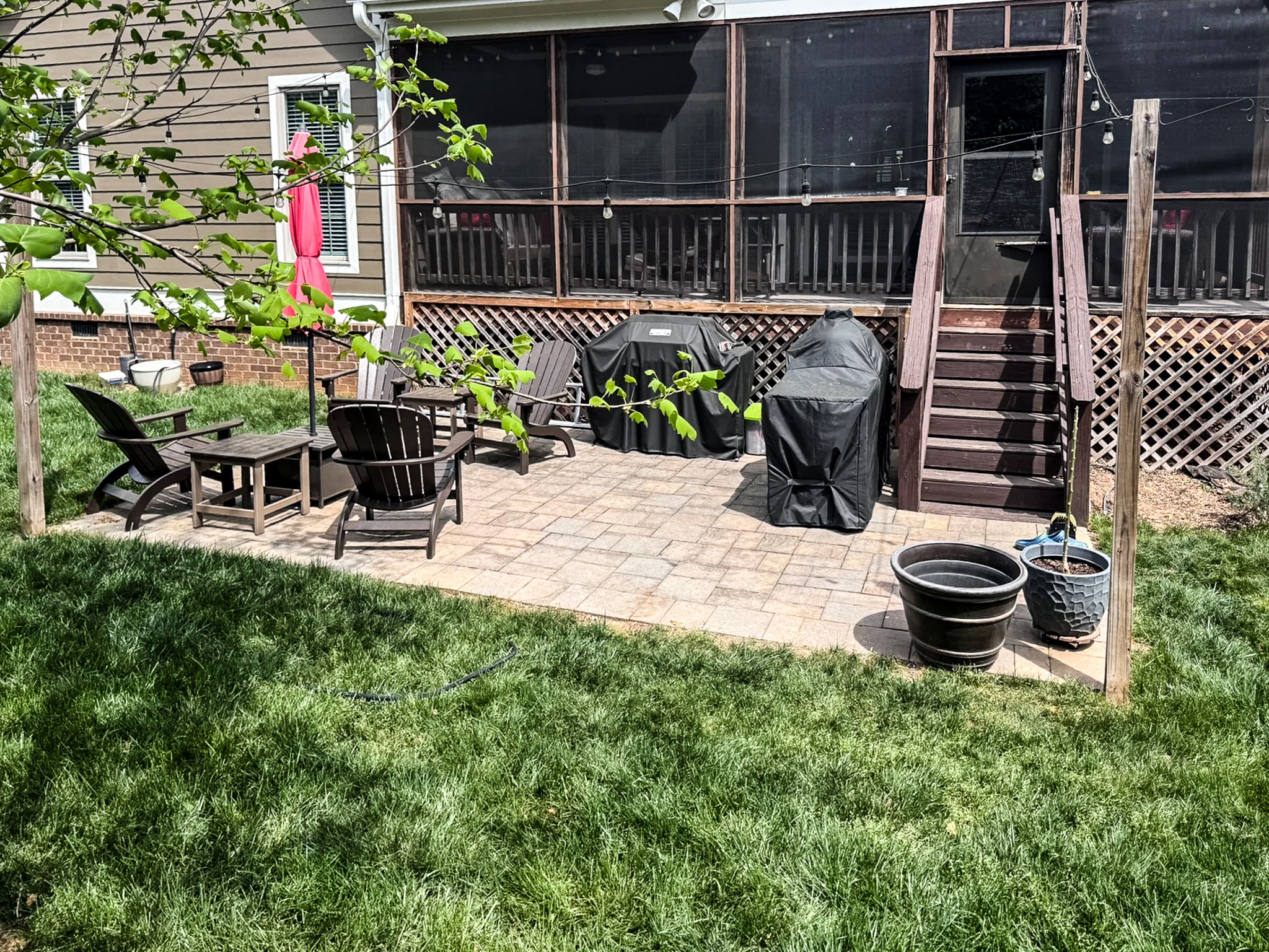
Below the deck, the original paver patio had shifted out of level over time. Pavers settle. They heave with freeze-thaw cycles, shift under foot traffic, and develop uneven surfaces that are both an aesthetic problem and a functional one. The decision was made not to relay the pavers but to replace the entire lower area with composite decking, which extended the usable, level outdoor living space and unified the look of the project from top to bottom.
Problem 4: Stair Placement
The original stair location did not serve the space well. As part of the rebuild, the stairs were repositioned to improve flow between the upper deck and the lower area, a change that sounds minor but meaningfully affects how a space gets used day to day.
The Materials: Trex Enhance in Cinnamon Cove
The decking throughout the project, upper deck, screen room floor, and the new lower level replacing the pavers, is Trex Enhance composite decking in Cinnamon Cove color.
Trex Enhance is the entry-level line in the Trex composite family, designed for homeowners who want the core benefits of composite decking without moving into the premium price tier. Trex Enhance Naturals cost only $10 a year to maintain, which amounts to the cost of soap and water for an occasional cleaning. There is no staining. No sealing. No annual ritual.
Trex Enhance carries a 25-year limited residential warranty.Wood decking warranties are typically shorter, lasting 1 to 10 years, and often excluding issues like weathering and rot.The warranty gap is not a minor detail. It reflects what each manufacturer is actually willing to stand behind.
Cinnamon Cove is a warm, earthy brown that reads as natural in outdoor settings. It does not require periodic color refreshing, does not absorb moisture, and does not rot. For a project replacing a wood structure that failed due to moisture exposure in a high-rainfall climate, those properties are not optional upgrades. They are the baseline requirement.
The Railing: A Three-Tone Detail That Earns a Second Look
The railing system on this project is where the design goes from functional to genuinely distinctive.
Armor Xteriors installed the Trex Transcend Crown railing system with a combination that creates a three-tone visual effect: white composite post sleeves, black aluminum round balusters, and the Crown top rail in a contrasting finish. The result is a railing that layers color and material in a way that most decks in the area simply do not have.
The Trex Transcend system is specifically designed to allow homeowners to mix and match composite rails with composite or aluminum balusters to create a tailored railing look. The black aluminum round balusters are a 3/4-inch diameter aluminum product that adds a modern touch while remaining sleek enough not to distract from the view.The white composite post sleeves are hollow sleeves that fit over a standard 4×4 pressure-treated post, giving the posts a clean, finished appearance without the bulk of a solid composite post.
The Crown Top Rail is built from composite materials that resist rotting, warping, peeling, and splintering, and requires no painting or staining.It connects between posts and holds the balusters securely in place when paired with the Universal Bottom Rail below.
The three-tone combination, white post sleeves, black aluminum balusters, and the Crown top rail, is the kind of detail that photographs well and tends to be the first thing visitors comment on. It also costs nothing additional to maintain over time, which is the practical version of the same story.
What Changed: The Full Picture
The project scope covered every element of the outdoor living space:
The upper deck was fully rebuilt from the substructure up using Trex Enhance Cinnamon Cove decking throughout. The screen room was rebuilt on the new frame, restoring its structural integrity and giving it a floor that matches the deck. The stair location was repositioned to improve the flow between levels. And the lower paver area was removed entirely and replaced with composite decking, extending the level, usable outdoor space and connecting the visual language of the project from ground to railing cap.
The result is a three-level outdoor living space, upper deck, screen room, and lower composite area, that functions as a unified system rather than a collection of independent elements built at different times with different materials.
The Long-Term Math
For homeowners weighing composite against wood on a project of this scope, the numbers are worth working through directly.
Professional deck staining runs $450 to $1,000 for materials and labor on a typical deck, with most homeowners paying around $850 per service. A deck should be stained every two to three years to maintain its appearance and structural protection. On a two-year cycle, that is $425 per year in staining costs alone on a deck in good condition. A larger deck with a screen room and a paver area to maintain separately adds to that number every single year.
When a wood deck requires major repairs, deep cleaning, and stripping of old stain, cleaning and preparation costs run $3 to $6 per square foot before a single drop of stain goes down. On a larger deck and screen room project, that prep cost alone can run well into the thousands before any actual repair work begins.
Trex Enhance requires only $10 per year in maintenance.Over a 25-year warranty period, the maintenance cost difference between a wood deck requiring professional staining every two to three years and a Trex Enhance composite deck is significant enough to materially affect the total cost of ownership, often by $8,000 to $15,000 or more depending on deck size and the number of missed seasons that require additional prep work.
The Soddy Daisy homeowner had already paid the full price of that math in the form of a complete rebuild. The Trex Enhance system they have now is the last deck maintenance conversation they will need to have for a generation.
A Note on the Screen Room
Screen rooms attached to wood decks face an accelerated version of the same moisture problem the deck faces. The screened enclosure traps humidity. The wood framing sits in a consistently moist microenvironment, and any gap in surface protection becomes a direct path for moisture to enter the framing.
Rebuilding the screen room on a composite deck frame addresses the moisture problem at the foundation of the structure. The floor of the screen room is now Trex Enhance composite, the same material as the deck, and the framing is supported by a substructure built for the rebuild rather than inherited from the original construction.
The Bottom Line
The Soddy Daisy project is a useful illustration of where wood deck maintenance eventually leads in a climate that receives 55 inches of annual rainfall. Not through neglect. Not through poor workmanship. Just through the normal cumulative effect of moisture on wood in East Tennessee over time.
The replacement, a full composite deck, rebuilt screen room, repositioned stairs, new lower-level composite area, and a three-tone Trex Transcend railing system, is built to perform in exactly the climate that ended the previous structure.
Trex decking is made from up to 95% recycled materials and backed by warranties ranging from 25 to 50 years, ensuring long-term performance against material defects, fading, and staining.For homeowners in Soddy Daisy and across the greater Chattanooga area evaluating a similar project, that warranty is not just a product feature. It is the clearest signal of what the material is actually built to handle.
Armor Xteriors is a Trex ProPlatinum certified contractor serving Soddy Daisy, Chattanooga, and surrounding communities in Hamilton County. To learn more about composite deck rebuilds and Trex Transcend railing systems, click here to schedule a free in-home design consultation.
A case study on the Trex RainEscape Under-Deck Drainage System and what it actually means for homeowners in East Tennessee
There is a space underneath a lot of elevated decks in the Chattanooga area that homeowners never think about. It is technically there. It is protected on three sides. It has potential. But the moment it rains, it becomes a wet, muddy, unusable patch of ground that nobody wants to be near.
That was exactly the situation for a homeowner in Ooltewah, Tennessee, who reached out to Armor Xteriors for a full deck rebuild. The existing deck had run its course structurally, and the space below it had never been anything more than a storage area for things the family did not really want to look at. When the weather turned, even that stopped being practical. (It’s a familiar story — see a similar complete outdoor living transformation in Ooltewah we completed for another homeowner.)
The solution was not just a new deck. It was a complete rethinking of what that space could be, using a product built specifically for this problem: the Trex RainEscape Under-Deck Drainage System.
The Problem? 51 Inches of Rain Per Year and a Deck That Ignored All of It
Ooltewah gets roughly 51 inches of rain per year, well above the U.S. average of 38 inches. Precipitation hits the area on approximately 99 days out of the year, which means that for more than a quarter of all days on the calendar, rain is a factor in whether or not an outdoor space is usable.
For a homeowner with an elevated deck, that math is brutal. Traditional deck construction channels water directly down through the decking, through the joists, and onto whatever is below. There is no redirection. No management. The space below the deck gets as wet as open ground, sometimes wetter because the deck above concentrates water flow in specific channels.
The result is a space that is unusable for a significant chunk of the year, contributes to moisture damage on the deck substructure over time, and sits as a wasted opportunity in the most-used part of the home’s outdoor square footage.
For this Ooltewah family, the area underneath their deck had never been anything. The rebuild was the chance to change that.
The Solution: Trex RainEscape Under-Deck Drainage System
The Trex RainEscape system is an under-deck drainage system installed between deck joists before the decking boards go down. It is made up of a network of troughs and gutters that captures water coming through the deck boards above and channels it to downspouts at the edge of the deck, directing it completely away from the space below.
The system provides 100% protection of the deck substructure from moisture. That is not marketing language. That is the product specification from Trex. The troughs are made from 20-mil material, installed between joists at a slight slope to move water efficiently toward the downspouts, and sealed with butyl tape at all overlaps and connections.
The product is tested to perform in temperatures ranging from -40 degrees to 165 degrees Fahrenheit, which means it handles Tennessee summers and the occasional ice event without issue. It comes backed by a 25-year warranty directly from Trex, and when installed by a certified Trex contractor, that warranty is further reinforced by the installer’s coverage.
For the Ooltewah project, Armor Xteriors installed the RainEscape system as part of a complete deck rebuild, meaning the substructure was fresh, the joists were clean and properly sloped, and the system was integrated from the ground up rather than retrofitted. That matters. A properly sloped installation with sealed overlaps performs significantly better than a system added after the fact to an existing structure.
What Changed: Square Footage Without Construction
This is the part of the Trex RainEscape story that does not get talked about enough.
Adding a room to a home costs, on average, between $80 and $200 per square foot in Tennessee, depending on the type of construction, finishes, and permitting involved. A 200-square-foot addition could run anywhere from $16,000 to $40,000 or more, and that does not account for the time, disruption, or permitting process.
The under-deck space in this Ooltewah project was approximately 200 square feet. Before the rebuild, it was a wet, underutilized area. After the Trex RainEscape installation, it became a fully protected, weather-independent outdoor living space capable of housing seating, lighting, ceiling fans, and entertainment equipment.
The family did not add square footage to their home in the traditional sense. But they gained functional, usable space that had never existed before. The cost of the RainEscape system itself runs roughly $2.50 to $4.00 per square foot installed, a fraction of what traditional square footage costs to add.
That is a meaningful financial equation for any homeowner evaluating how to expand their usable living space.
How the Installation Works
For anyone considering this system, it helps to understand what the installation actually involves, because it directly affects the quality of the outcome.
The troughs are installed between deck joists before the decking surface is laid. Each trough is 19-5/8 inches wide, sized to fit snugly between standard joist spacing. Butyl tape is applied at all overlaps and seams to prevent water from bypassing the trough. The troughs are stapled into place every few feet and maintain a slight downward slope toward the downspout locations at the deck’s edge.
The downspouts are positioned to move water away from the foundation and the space below. Once the decking is installed over the top, rain that comes through the boards above hits the trough surface, follows the slope, and exits through the downspouts cleanly. The space below stays dry.
On the Ooltewah project, the integration with a full deck rebuild meant the joists were set with the slight slope already accounted for, and the downspouts were positioned as part of the overall design rather than added as an afterthought. That kind of planning-forward approach is one of the advantages of doing a full rebuild versus attempting a retrofit.
The Broader Case for Under-Deck Drainage in East Tennessee
Ooltewah is not unique in this region. The entire Chattanooga metro, including surrounding communities in Hamilton County, gets weather patterns that make under-deck drainage genuinely practical rather than optional for elevated decks.
The area averages over 150 days per year with some form of precipitation. Summers are hot and humid, with afternoon thunderstorms that are common from June through August. The deck surface itself may dry quickly, but without a drainage system underneath, the substructure and the below-deck space absorb moisture repeatedly throughout the season.
Over time, that moisture exposure degrades wood substructures, creates conditions for mold and mildew growth, and turns a potentially useful outdoor space into a maintenance liability. A system like Trex RainEscape addresses all three of those problems simultaneously by removing moisture from the equation entirely.
The 25-year warranty on the system also means that for the life of the deck itself, the homeowner has coverage on the drainage performance. That is a long-term assurance that most home improvement products cannot offer.
The Result
The Ooltewah homeowners went from a worn deck and a useless, weather-exposed space below it to a new Trex deck above and a dry, functional outdoor area underneath that they can actually use year-round.
They did not build an addition. They did not add to the footprint of their home. They recovered square footage that was already there and had simply never been protected.
For homeowners in the Chattanooga area sitting on an elevated deck with unused space below it, this project is a practical illustration of what is possible. The combination of a quality deck rebuild and the right drainage system changes the math on what outdoor living space can look like.
Armor Xteriors is a Trex ProPlatinum certified contractor serving Chattanooga, Ooltewah, and surrounding communities in East Tennessee. To learn more about deck rebuilds and Trex RainEscape installations, visit ArmorXteriors.com.
If you ask homeowners what they want from a deck, the answer is usually simple: They want a place to enjoy.
What they don’t want is another weekend project.
Unfortunately, that’s where many traditional wood decks begin to fail homeowners over time. The idea of a beautiful backyard gathering space sounds great when it’s first built, but years later many homeowners find themselves dealing with splintered boards, fading stain, loose railings, warped decking, or structural deterioration that slowly turns a favorite outdoor space into something they avoid.
That’s one reason we continue seeing homeowners throughout Chattanooga and surrounding communities like East Brainerd moving toward composite decking systems like Trex. The conversation usually doesn’t start with luxury.
It starts with frustration.
“I don’t want to stain this thing again.”
“I’m tired of replacing boards.”
“I just want something that lasts.”
Over the years, we’ve seen the same patterns repeatedly: homeowners aren’t necessarily replacing wood because they dislike the appearance of wood. They’re replacing it because they become tired of everything that comes with owning it.
The goal shifts from simply having a deck to having a deck they can actually enjoy.
Key Takeaways
For homeowners considering a deck replacement, here are some of the biggest reasons composite decking continues gaining popularity:
No annual staining or painting
Minimal maintenance requirements
Resistant to splintering and cracking
Improved appearance consistency over time
Long-term durability
Strong manufacturer warranties
Better long-term ownership experience
Lower lifetime maintenance costs
Increased curb appeal and backyard usability
But the biggest reason may be something less obvious: Time.
People want their weekends back.
Why Wood Decks Often Become High-Maintenance Projects
But decks experience constant exposure to environmental stress:
Rain
UV exposure
Temperature fluctuations
Humidity
Moisture retention
Mold and mildew growth
Foot traffic
Furniture movement
Tree debris and pollen
Around Chattanooga and East Brainerd specifically, homeowners deal with something we frequently see affecting exterior products:
Hot summers combined with high humidity and significant seasonal moisture. Wood naturally expands and contracts as moisture changes.
Over time this movement contributes to:
Cracking: Repeated expansion and contraction can create stress within wood fibers.
Splintering: A common issue for families with children or pets.
Warping: Boards begin twisting or cupping.
Fading: Sun exposure gradually breaks down stains and finishes.
Rot: Moisture eventually finds weak areas.
Loose Fasteners: Movement over time can create instability. Individually, none of these problems feel major. Collectively, they slowly turn a deck into an ongoing project.
The Hidden Cost of Wood Deck Ownership
When homeowners compare decking materials, they often focus only on initial installation cost.
But the bigger conversation usually involves ownership cost.
Many homeowners underestimate expenses such as:
Stain
Sealers
Pressure washing
Replacement boards
Fastener repairs
Labor
Time
The financial cost adds up.
The time cost can be even larger.
Think about what recurring maintenance often looks like:
Weekend one: Pressure wash.
Weekend two: Allow drying.
Weekend three: Sand problem areas.
Weekend four: Stain or seal.
Repeat. And then repeat again.
For some homeowners that’s acceptable.
For many others, it eventually becomes exhausting.
Why Trex Has Become One of the Most Popular Alternatives
Composite decking isn’t new anymore. But Trex has evolved significantly from earlier generations of composite products.
Modern Trex products are designed around a simple principle: Reduce maintenance while maintaining appearance.
That sounds simple. In reality, that’s solving multiple problems simultaneously.
Benefit #1: No Staining or Painting
For many homeowners, this alone becomes the deciding factor.
With traditional wood:
Sanding
Staining
Sealing
Repainting
…becomes part of ownership.
With Trex decking, that routine largely disappears The goal isn’t just saving money. It’s eliminating repetitive work.
Instead of planning weekends around deck maintenance, homeowners can simply use their deck.
Benefit #2: Reduced Maintenance Requirements
One thing homeowners often say after a deck replacement is:
“I forgot what it feels like not having another project waiting on me.”
Trex requires very little compared to wood.
Typical care generally involves:
Basic cleaning
Occasional washing
Clearing debris
That’s substantially different from annual restoration work.
Benefit #3: Long-Term Durability
Durability isn’t just about surviving. It’s about maintaining appearance and function over time. The Trex Enhance Naturals line is designed for long-term performance and is rated for decades of use under normal conditions.
In our experience, homeowners often care less about technical specifications and more about practical questions:
“Will it still look good years from now?”
“Will I have to keep fixing things?”
“Will I regret spending the money?”
Those questions matter more than a brochure.
Benefit #4: Consistent Appearance
Natural wood has variation. Some homeowners love that. Others want a cleaner, more intentional appearance.
Composite decking provides a more consistent visual look across the deck surface.
Picture framing designs can further elevate the appearance. Instead of looking like a simple deck, it begins feeling like an outdoor living space.
East Brainerd Deck Replacement Case Study
Sometimes the biggest difference isn’t visible on a product sample. It’s visible when standing on the finished deck.
Recently, we completed a deck replacement project in East Brainerd for homeowners dealing with an aging wood deck that had reached the point where safety and usability had become concerns.
Their previous deck had deteriorated significantly. Boards were heavily weathered. The structure had begun showing its age. And honestly, it had become one of those situations homeowners eventually recognize:
“This isn’t getting repaired anymore.”
It was becoming a complete replacement project.
Homeowner Goals
The homeowners wanted:
Something safer
Something cleaner
Something that looked updated
Minimal maintenance
Long-term durability
Most importantly: They wanted to stop worrying about it.
Materials Used
For this project we installed:
Decking Surface
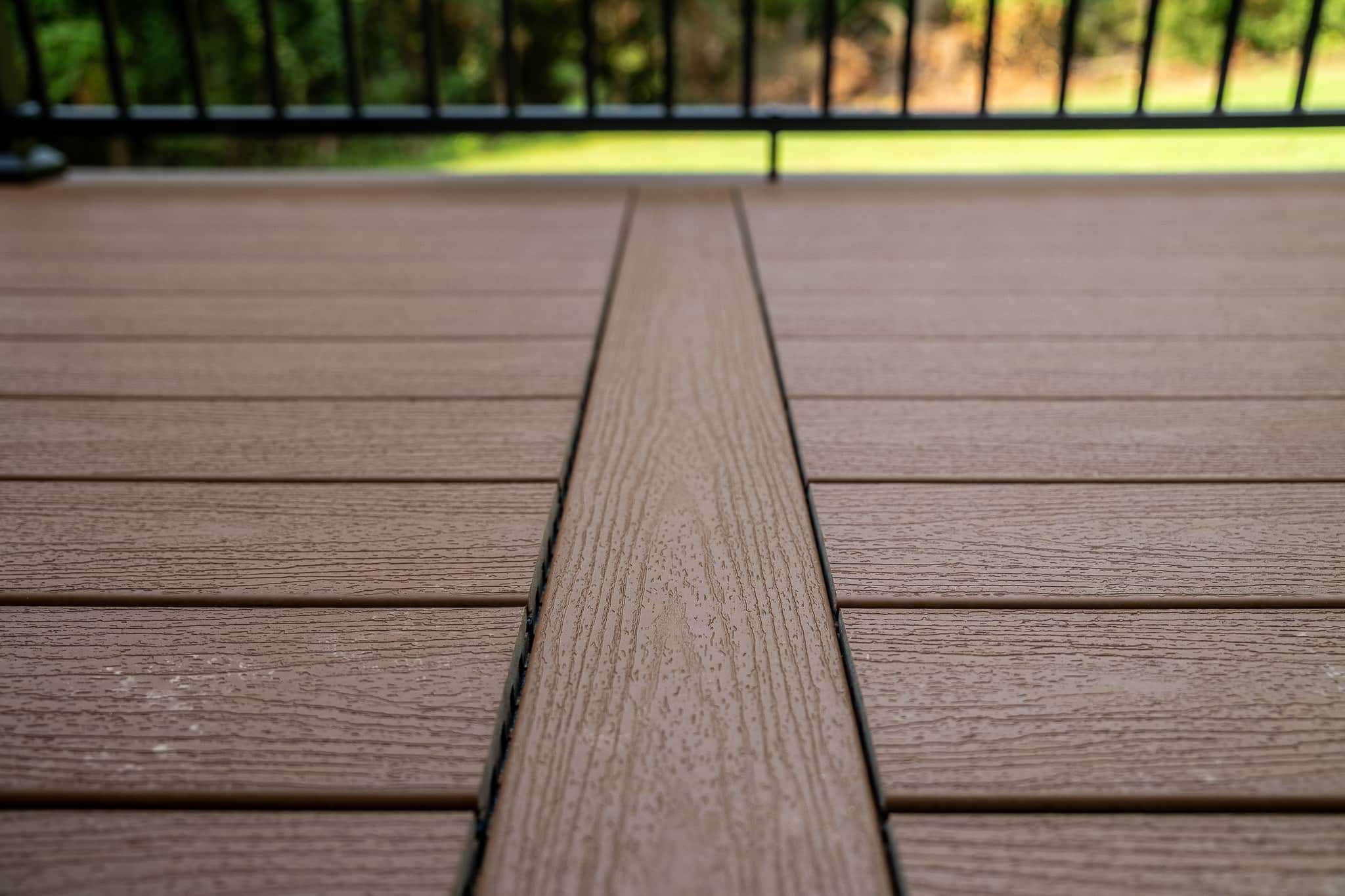
Trex Enhance Naturals in Honey Grove
Picture Frame Border
Trex Naturals Cinnamon Cove
Railing
Trex aluminum railing system
Why Picture Framing Matters
One design detail that often gets overlooked is picture framing.
Picture framing creates a border around the deck perimeter using contrasting colors. In this project, the Cinnamon Cove border created visual definition around the Honey Grove decking field. The result wasn’t simply a larger deck. It looked intentionally designed.
Small design choices often create surprisingly large visual improvements.
The Difference After Completion
The difference wasn’t just appearance.
The homeowners moved from:
Aging wood
Potential safety concerns
Constant maintenance needs
to:
Modern appearance
Stronger overall system
Minimal upkeep
Long-term durability
Instead of planning around maintenance schedules, they can simply enjoy their backyard space.
Another Advantage Many Homeowners Overlook: Warranty Protection
Products matter. Installation matters too. Both affect long-term performance.
Armor Xteriors is a Platinum-level installer, allowing homeowners access to enhanced installation expertise and warranty options.
For qualifying projects, homeowners may receive warranties up to 10 years through Armor Xteriors in addition to manufacturer coverage.
That creates something homeowners often value: Confidence.
Frequently Asked Questions
Does Trex require staining?
No.Trex decking does not require routine staining or painting like traditional wood decks.
How long does Trex last?
Trex products are designed for long-term durability and many product lines include warranties extending multiple decades.
Does Trex splinter?
Unlike traditional wood, composite decking does not create typical wood splinters.
Is composite decking worth the cost?
Many homeowners find that reduced maintenance expenses, improved durability, and long-term convenience justify the investment.
Does Trex get hot?
Like nearly all outdoor materials exposed to direct sunlight—including concrete, wood, and pavers—Trex can become warm. Color selection, shade coverage, and regional climate conditions can influence surface temperatures.
The Best Deck Is the One You Actually Use
The purpose of a deck isn’t maintenance.
It’s memories.
It’s cookouts.
Morning coffee.
Family gatherings.
Kids playing outside.
Watching football.
Quiet evenings.
When homeowners replace deteriorating wood decks, they’re usually not buying boards. They’re buying time back.
The East Brainerd project reminded us of something we see often:
People rarely call because they simply want a new deck. They call because they’re tired of dealing with the old one. And sometimes the best upgrade isn’t adding something new. It’s removing a recurring problem entirely.
An exterior remodel, whether it’s a new roof, energy-efficient windows, or modern siding, is one of the best ways to boost your Chattanooga home’s curb appeal and resale value. However, these projects are significant investments.
If you’re planning a roofing, siding, deck, or window project in Chattanooga, choosing the right contractor isn’t just about price or availability, it’s about protection.
And one of the biggest mistakes homeowners make?
Hiring someone who says they’re licensed… but isn’t properly licensed for the work, or worse, doesn’t pull permits at all.
Let’s break down why this matters, especially here in Chattanooga and the surrounding North Georgia area. Read more
Quick answer: Yes, Trex costs more than wood up front. In Chattanooga in 2026, a mid-size pressure-treated wood deck runs about $28,000–$32,000, and a similar Trex deck runs about $38,000–$45,000, roughly 30–40% more. But wood needs staining every few years ($1,500–$2,500 each time) plus board and structural repairs. Over 20 years, a wood deck typically costs $45,000–$60,000 or more, while Trex stays around $42,000–$45,000. For most homeowners who plan to stay put, Trex ends up costing the same or less.
If you’re planning a new deck in Chattanooga in 2026, one question matters more than any other: Is wood still the better value — or does Trex make more financial sense long term?
Everyone loves the natural look of wood. But very few homeowners love the sanding, staining, sealing and repairs that come with it. That’s exactly why high-performance composite decking has become the dominant choice across Southeast Tennessee.
Designed with lasting beauty, incredible durability and easy maintenance, composite decking eliminates the compromises that traditionally came with outdoor living spaces. And when you compare Trex head-to-head against wood — especially in Chattanooga’s climate — the long-term cost picture becomes clear.
Chattanooga summers can be relentless. With afternoon highs regularly climbing into the 90s, a traditional composite deck can feel like a stovetop under bare feet. Enter Trex’s latest heat mitigation technology—engineered to reflect sunlight and reduce surface temperatures by up to 35%. Here’s why choosing a Trex deck isn’t just about low maintenance and durability; it’s about creating a cooler, more comfortable outdoor living space right here in the Scenic City. Read more